
Our History
35 Years of Lifelong Learning at Florida State University
What began in 1991 as an idea shared by a small group of lifelong learners has grown into a vibrant community connected by curiosity, friendship, and a love of learning.
Over the past 35 years, OLLI at FSU has changed names, expanded locations, introduced travel and scholarships, earned national recognition, and welcomed generations of members. Through every chapter, one thing has remained constant: the belief that learning should never stop.
35 Years at a Glance
Our story begins.
The Senior Connection takes shape at FSU.
First classes offered.
Nine founding members help launch the program.
The Senior Academy.
Membership grows to approximately 70.
A new home.
The Academy moves to the Pepper Institute.
OLLI at FSU is born.
The Academy joins the national Osher network.
$1 Million Endowment.
OLLI earns its first major Osher endowment.
A second $1 Million.
Membership and programming reach new heights.
OLLI expands west.
OLLI at FSU PC30A launches.
Learning without walls.
Zoom keeps members learning and connected.
More ways to connect.
In-person, Zoom and hybrid learning continue to grow.
Celebrating 35 Years!
Honoring our history while looking toward what's next.
Where It All Began
In 1991, lifelong learning at Florida State University was just a gleam in the eye of Susan Lampman, who worked at FSU's Center for Professional Development. Susan had learned about a national movement opening the doors of colleges and universities to students of all ages and began working with a small group of future founding members to bring the concept to FSU.
They started from scratch, with no dedicated funding for salaries or instructors. Under the leadership of Mary Pankowski, the Center for Professional Development provided classroom and audiovisual space and supported Susan's work on the new program.
By 1992, nine official founding members had joined the effort: Don Patton, Betty Patton, Margaret Hamilton, Grace Maxwell, Inez Frink, William Gorbett, Mildred Zindler, Vera Morse and Lena Allen.
That spring, the organization offered its first two courses: Critical Issues in the 1990s and The Middle East Unveiled.
By 1993, word had spread. Thirty-five members participated in four classes during the spring and fall semesters, and Dr. Harry Horwich became the first president of the newly established steering committee.
In 1994, with membership approaching 70 and six classes offered each semester, the organization adopted a shorter name: The Senior Academy.
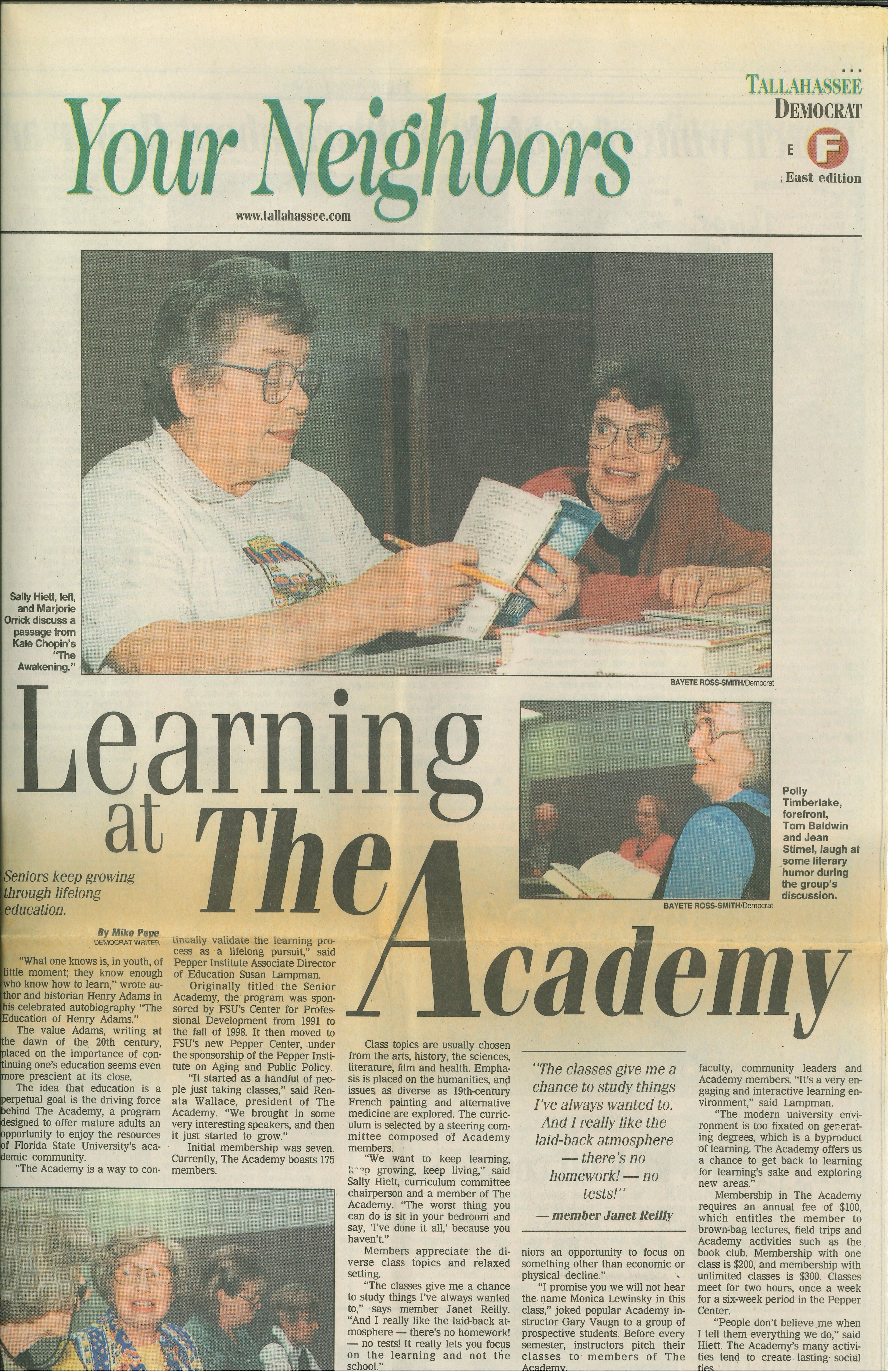
The Academy makes headlines. A Tallahassee Democrat feature captures members learning, discussing and connecting in OLLI’s early years.
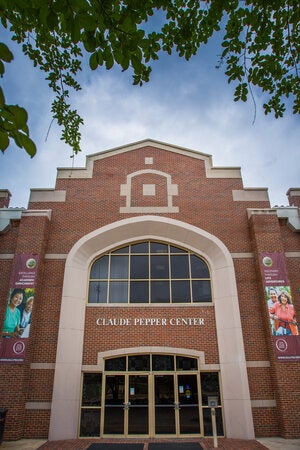
I am thankful that OLLI has a strong relationship with the university, and a home within the College of Social Sciences and the Pepper Institute on Aging and Public Policy.
Finding a Permanent Home
As the Senior Academy continued to grow, changes at the Center for Professional Development brought financial challenges. A contribution from the late Don and June Alford provided important support and encouraged innovations to attract new members.
A major turning point came in 1998. Susan Lampman moved to the Pepper Institute on Aging and Public Policy and received permission to bring the Academy and its approximately 80 members with her.
The Claude Pepper Center welcomed what was now known as The Academy at FSU, providing meeting and office space and making the program part of the mission of the Pepper Institute on Aging and Public Policy.
The new affiliation helped formalize the relationship between the Academy and the university. Bylaws were written, committees were established, and members became increasingly involved in planning and managing the program.
In 2001, Terry Aaronson was hired as program coordinator, and the Academy celebrated its 10th anniversary.
The Academy also received a generous endowment created by the late Ralph Cook, an early and active member who cared deeply about the organization's long-term sustainability.
Expanding Beyond the Classroom
The Academy continued to broaden its reach. Classes were offered at the FSU Reservation and other locations throughout the community, including Westminster Oaks. Local and regional field trips became a regular part of the program.
The organization also entered a new technological era with its first computerized membership database.
By the 2005-06 academic year, the Academy's photo directory listed 156 members. In 2006, the organization celebrated 15 years of lifelong learning at FSU.
As members looked for ways to give back, the program's community impact began to grow as well.
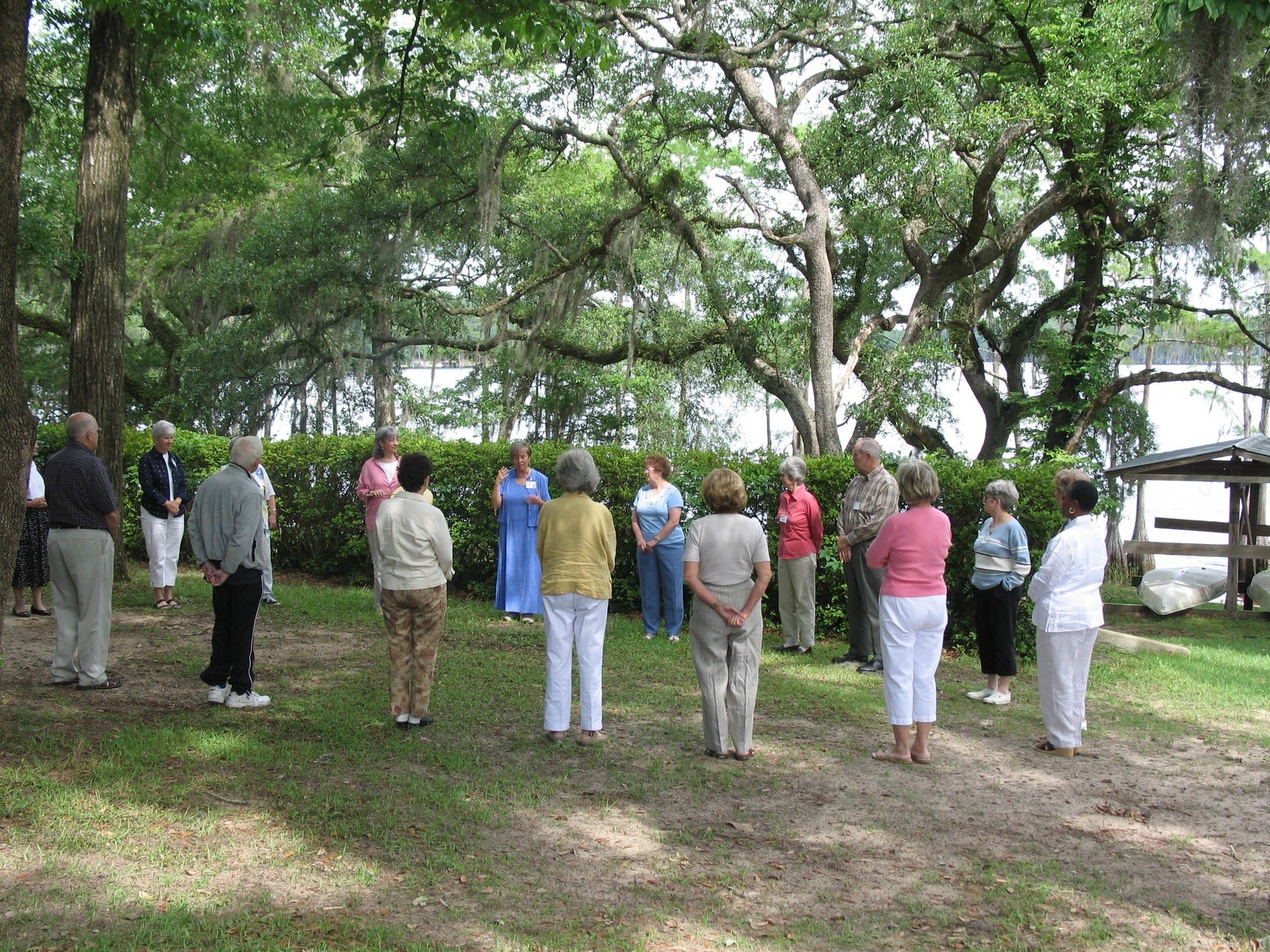
The classroom takes a new form at the FSU Reservation, now FSU Lakefront Park.
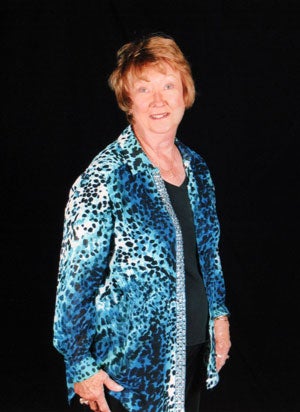
When I became the member president in 2007, I listened to high-quality lectures from top faculty from FSU, FAMU and TCC. I also participated in popular field trips with members who had local connections, making it possible for us to go behind the scenes in several organizations around town. I knew we were onto something good—something very special.
Becoming OLLI at FSU
In 2008, under member President Ramona Bowman, the organization's first scholarship was established. A student from FSU's College of Music became the first recipient.
That same year, Susan Lampman learned about the Bernard Osher Foundation's national lifelong learning initiative. She submitted a request for funding, and The Academy at FSU received a $50,000 grant and a new name: the Osher Lifelong Learning Institute at Florida State University.
The initial award came with an ambitious challenge: grow enrollment from approximately 300 members to 500 while continuing to demonstrate the quality and sustainability of the program.
Members and staff embraced the challenge. OLLI expanded its curriculum and activities while strengthening the organization.
After many years with the program, Susan Lampman retired as director. Corey Livingston briefly took the helm, and in 2011 Debra Herman became director.
Growing at Home and Around the World
With its first Osher endowment secured, OLLI continued to grow its curriculum, activities and scholarship program while expanding into more locations throughout the community.
New opportunities also took OLLI beyond Tallahassee. International travel began with the Semester at Sea Enrichment Voyage in 2012, followed by the OLLI Study Abroad Program in 2013, which focused on FSU campuses around the world.
Travel and Friendship Force Clubs helped open the door to even more national and international experiences.
Meanwhile, another challenge was underway. To qualify for a second Osher endowment, OLLI needed to double its 500-member enrollment, demonstrate a commitment to sustainability through annual fundraising, and continue expanding the quality and quantity of its curriculum and activities.
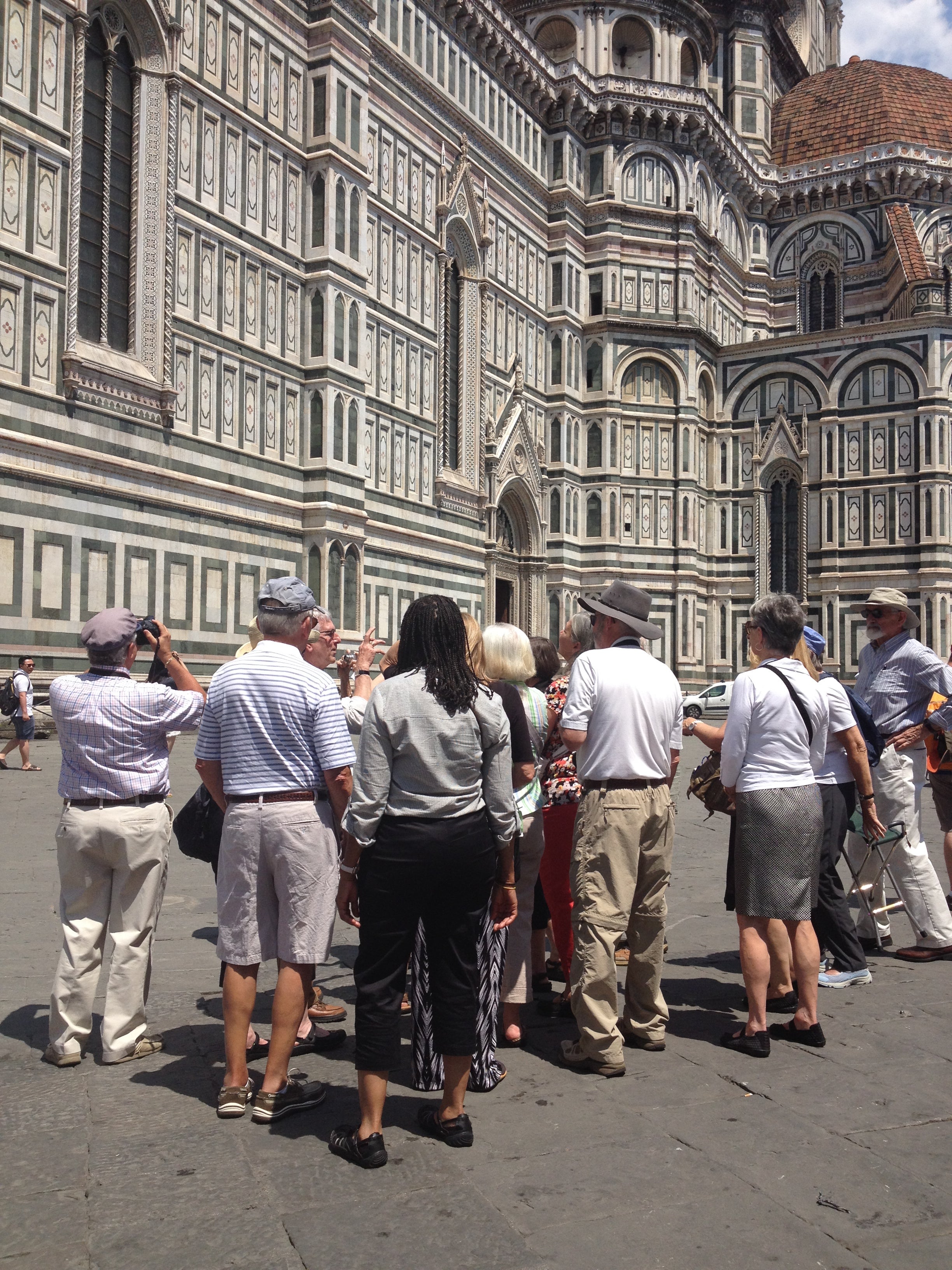
OLLI members traveling and learning together in Florence Italy, 2012
A Growing Community
OLLI had become much more than a collection of classes. Activities, clubs and member-led programs flourished, giving members new ways to connect through shared interests, friendship and service.
Book clubs, cultural and arts programs, field trips, language clubs, the Men's Group, Walking Club, Writers' Group and many other programs became an important part of the OLLI experience.
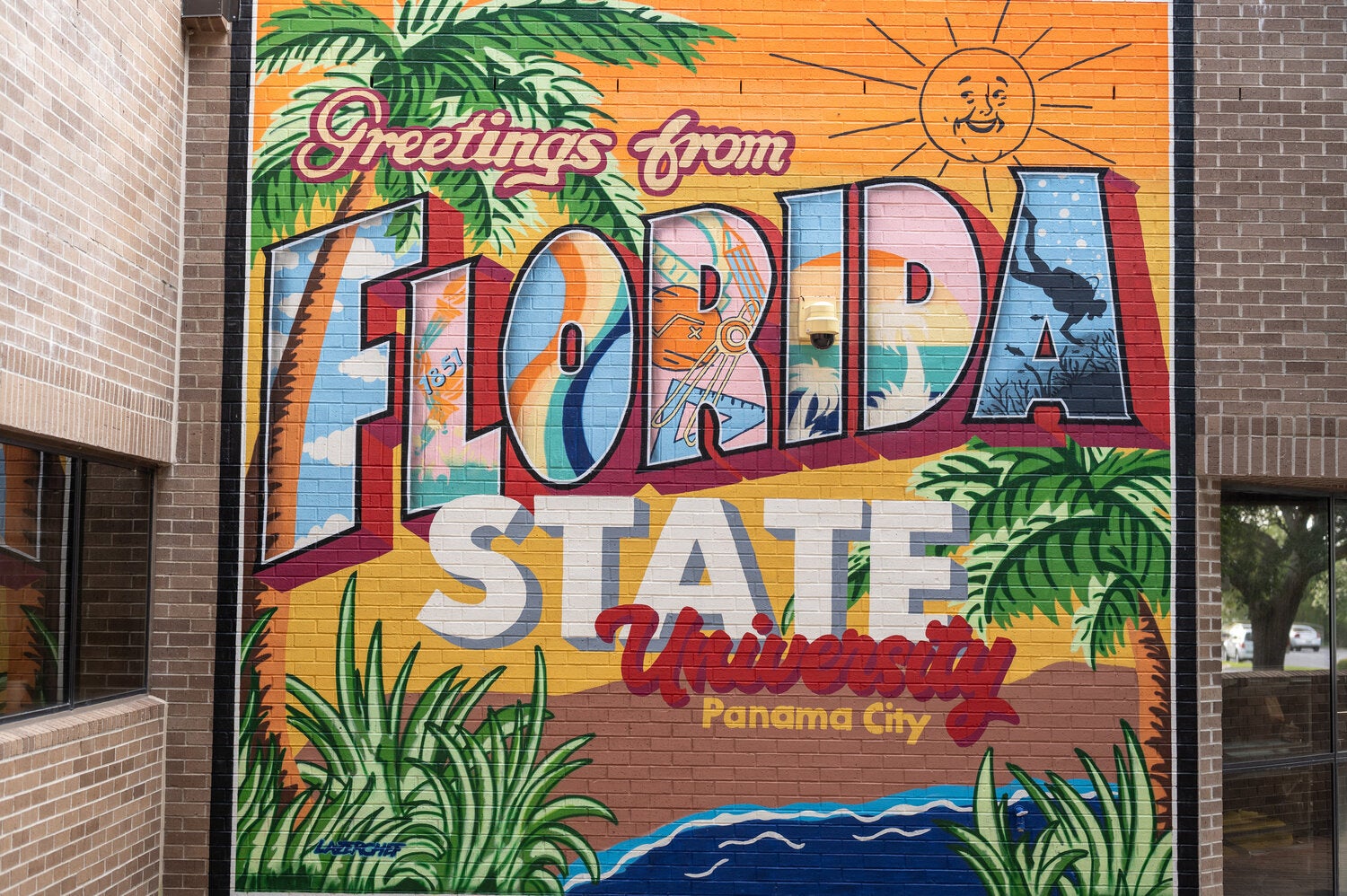
In 2019, OLLI expanded its reach to the Florida Panhandle with the creation of OLLI at FSU, PC30A.
The new program was gaining momentum when the COVID-19 pandemic brought in-person learning to an abrupt halt in early 2020.
Adapting, Connecting and Moving Forward
The pandemic changed how OLLI members learned and connected, but it did not stop them. Zoom opened new possibilities for lifelong learning, allowing members to remain engaged even when they could not gather in person.
As in-person programming returned, OLLI emerged with more ways to participate than ever before. In-person, Zoom and hybrid courses now connect learners across Tallahassee, the Florida Panhandle and beyond.
OLLI continues to offer a rich mix of courses, lectures, clubs, activities, travel, volunteer opportunities and community partnerships—all built around the idea that learning and connection enrich every stage of life.
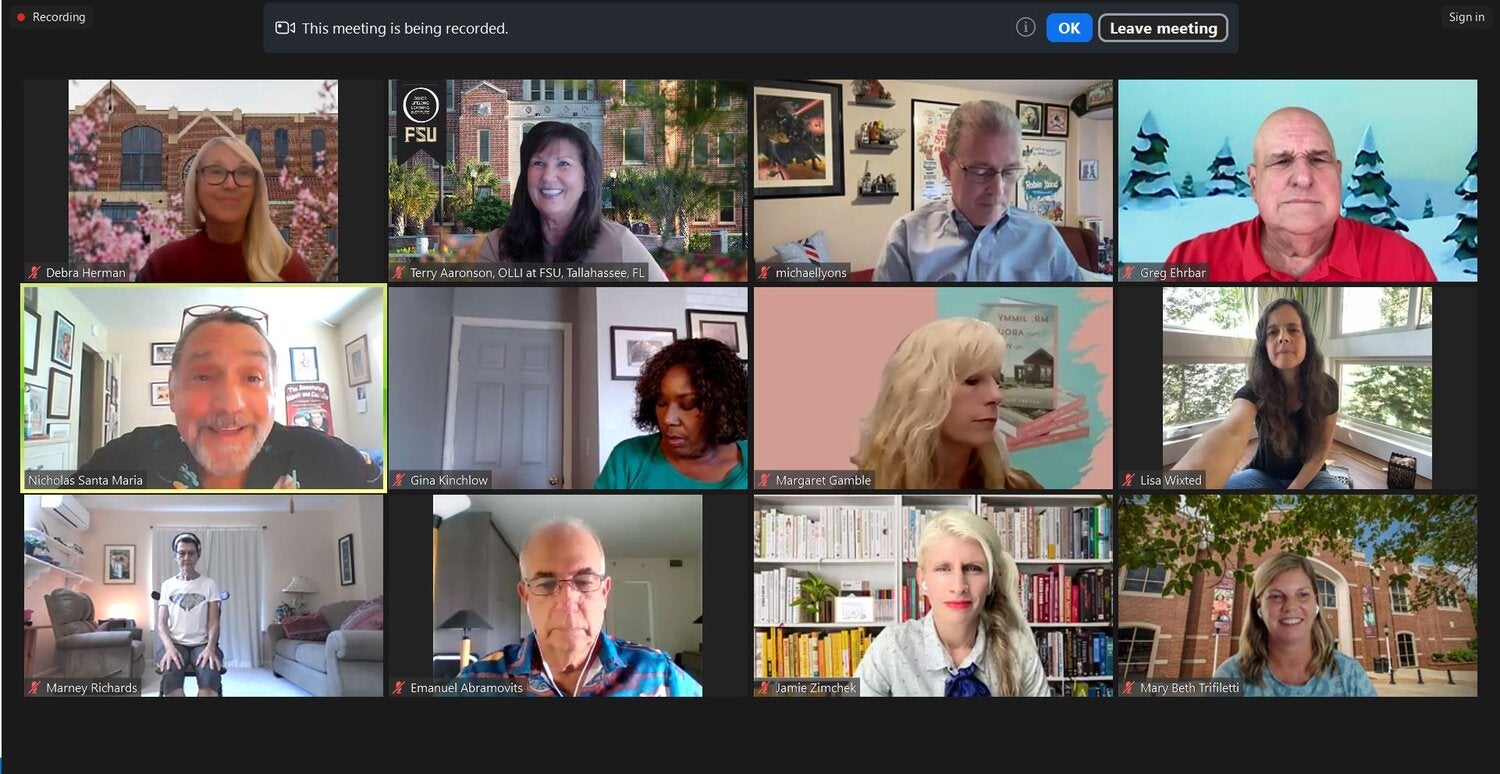
Zoom opened new ways for OLLI members and instructors to learn and connect.
Celebrating 35 Years
From nine founding members and two courses to a thriving community of lifelong learners, OLLI at FSU has come a long way since 1991.
OLLI has changed tremendously over 35 years, but the spirit that inspired its founders remains at the heart of the organization: curiosity, connection, friendship and the joy of discovering something new.
Members, regardless of where they may have earned their academic degrees, have come to think of OLLI at FSU as their alma mater for their garnet and golden years.
After 35 years, our story is still being written.
Presidents of OLLI at FSU and Its Predecessors
We are grateful to the member leaders who have helped guide our organization throughout its history.
| Academic Year | President |
|---|---|
| 1993-94 | Harry Horwick |
| 1994-95 | Richard Bullock |
| 1995-96 | John Graves |
| 1996-98 | Donald Alford |
| 1998-99 | Renate Wallace |
| 1999-00 | Jean Stimel |
| 2000-01 | Corena Ingram |
| 2001-02 | Grace Albritton |
| 2002-03 | Herb Rogero |
| 2003-04 | Ken Dowling |
| 2004-05 | Noreen Labitzke |
| 2005-06 | Cheri Apthorp |
| 2006-07 | Gay Howard |
| 2007-08 | Ramona Bowman |
| 2008-09 | Tom Foley |
| 2009-10 | Ruth Cates |
| 2010-11 | Nancy O'Farrell |
| Academic Year | President |
|---|---|
| 2011-12 | Susan Yelton |
| 2012-13 | Marlene Hanna |
| 2013-14 | John Van Gieson |
| 2014-15 | Eileen Sperl-Hawkins |
| 2015-16 | Fran Conaway |
| 2016-17 | Carroll Bewley |
| 2017-18 | Frank Alarcon |
| 2018-19 | Cindy Foster |
| 2019-20 | John Kilgore |
| 2020-21 | Harriet Waas |
| 2021-22 | Harriet Waas |
| 2022-23 | Jack Mapstone |
| 2023-24 | Bruce Bechard |
| 2024-25 | Janet Smith |
| 2025-26 | Debbie Justice-Obley |
| 2026-27 | Kent Putnam |